Often members of the public or non-clinical emergency services are the first on the scene following a road traffic collision. The Bystander Enablement Research Programme is a research study examining how these people could assess an injured patient. It focuses on simple, equipment‑free trauma assessments that may be performed by bystanders or non-clinical emergency responders before ambulance services arrive.
Why?
Early assessmentand communication at road traffic collisions can influence patient outcomes. This research aims to generate evidence to improve trauma assessment, decision‑making, and communication across public and professional responder groups, helping to inform future training and practice.
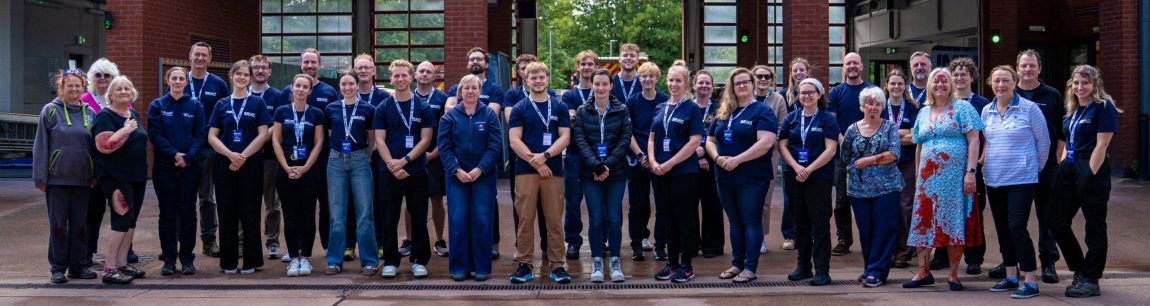
3 Days | 20 Researchers | 25 Volunteers | Exeter, UK
At the heart of this research is the simplified Bleeding Audit Triage Trauma (sBATT) score, a straightforward triage tool that requires no medical equipment. sBATT uses a number of checks to help estimate how serious someone’s injuries might be, and because it relies purely on observation and touch rather than equipment, sBATT has the potential to be used by anyone first on the scene – giving bystanders a structured way to assess a casualty and pass clear, useful information to emergency services.
This programme set out to evaluate how well different groups of people can carry out sBATT assessments in practice, using realistic scenarios designed to mimic real road traffic collisions.
This study is led by the Chief Investigator, Professor Tim Nutbeam, supported by the IMPACT Centre research team and sponsored by Devon Air Ambulance Trust. In this context, “sponsor” is a research term and does not refer to financial sponsorship. Rather, it means that Devon Air Ambulance is responsible for overseeing the study and ensuring it is carried out safely, ethically, and to a high standard. Financial support for the study is provided by external funders.
I would like to get involved in a research event like this: