


Road Injury Chain of Survival
A way to understand what happens after a crash and how we can make it better
Road injuries are a major cause of death and long-term disability worldwide. While much attention is rightly given to preventing crashes, what happens after a collision can make just as much difference to survival and recovery.
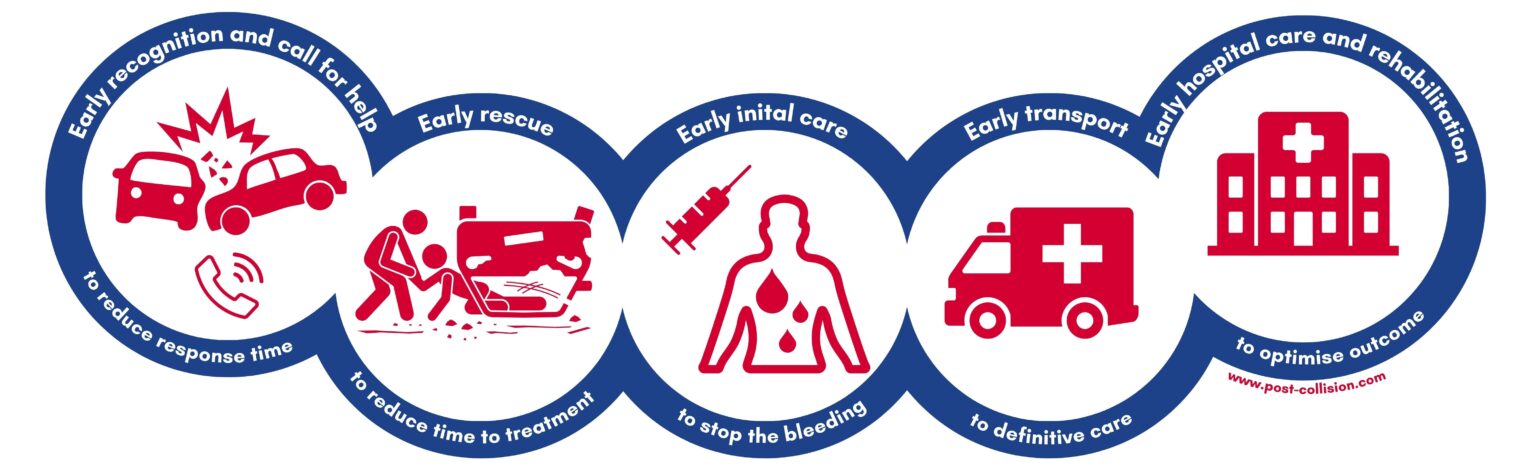
The Road Injury Chain of Survival is a simple framework that helps us understand those critical moments after a crash — from the first recognition that someone is injured, through to hospital care and recovery — and where things can go wrong or be improved.
Where did the idea come from?
The Road Injury Chain of Survival was conceived through collaborative work between IMPACT and our global health partners, including Willem Stassen at the University of Cape Town.
The idea builds on a well-known concept used in cardiac arrest care: the chain of survival. That approach showed that survival depends not on a single intervention, but on a sequence of linked actions, each of which matters.
Together, we adapted that thinking for road injury — recognising that trauma care involves many different people, systems, and decisions, often under pressure and in unpredictable environments.
The Five Links in the Road Injury Chain of Survival
The framework is made up of five connected links – each one represents a key stage in post-collision care:
Each link matters on its own, but the real strength of the framework is how the links connect. Weakness in one part of the chain can undermine everything that follows.
How We Use the Chain at IMPACT
At IMPACT, the Road Injury Chain of Survival is more than a diagram. We use it as a practical working tool.
To plan our research
We use the chain to decide where to focus research questions, which gaps matter most, and how different studies relate to each other. It helps ensure our work looks at the whole system, not just one isolated problem.
To frame gaps and systems
The chain makes it easier to see where delays, inequalities, or missed opportunities occur — whether that’s in bystander action, rescue practice, triage, transport decisions, or hospital pathways.
To guide translation into practice
Because the framework mirrors real-world care, it helps us move evidence into training, guidance, and policy. It gives practitioners, services, and decision-makers a shared language.
To describe and connect our projects
Across IMPACT, we use the Road Injury Chain of Survival to explain how individual projects fit together — and how they contribute to improving outcomes across the whole post-collision journey.
Why This Matters
Road injury care involves many people: members of the public, emergency services, healthcare professionals, engineers, planners, and policymakers. The Road Injury Chain of Survival provides a common framework that helps all of these groups see where they fit — and how improvement in one area supports the whole system.
Want To Learn More or Get Involved?
Road injury care involves many people: members of the public, emergency services, healthcare professionals, engineers, planners, and policymakers. The Road Injury Chain of Survival provides a common framework that helps all of these groups see where they fit — and how improvement in one area supports the whole system.
You can:
- Explore our research projects and see where they sit within the chain – Global, EXIT, BYSTANDER, Utstein & PSP
- Learn how we translate evidence into real-world practice – IMPACT Outputs
- Get in touch if you’re interested in collaboration, partnership, or applying the framework in your own setting – Get Involved